Communications Manager Amber Thompson spoke with artist Di Stovall about her and her husband Lou Stovall’s printmaking collaborations with Paul Reed, as well as their friendship with Reed and his wife Esther.
Amber Thompson: How did you meet Paul Reed?
Di Stovall: I met him through my husband. We weren’t married at the time. I’d been in D.C. and I left because my father got ill, and when I came back, I was going to work with Lou, and he was already doing a print with Paul. They had met, and I guess the first one was Barcelona. And that’s actually still my favorite. He just hit it off with Paul and vice versa. It was just a great friendship they had. And with me too, and with Esther too.
Lou’s big ambition was to do those prints with no overlap. They just had to butt out perfectly, and if it’s an angle piece, it’s even harder to have them so that they don’t overlap and then you use a darker color to hide the overlap. Paul was just such a wonderful, kind person, too. And he and Lou just loved their relationship. Then Lou moved to another building and that’s when Lou did Zigfield, the second print he did with him. Equally as difficult. And then they did a few prints that were a lot more fun. Paul would come over, and Lou had a workshop with other artists and kids around, and things like that. And Paul would come in; if Lou was busy, he would just pick up a broom and sweep or he would go chat with the kids and help them with what they were trying to do. He was just that kind of person. He was really special. Sometimes Esther would bring dinner in for Lou and his staff of young people who wanted to learn about printmaking. And Esther would feed all of us.
AT: Were you working with the two of them on some of Paul Reed’s prints?
DS: I was. I sort of did it slowly because Lou couldn’t afford to hire a bunch of people. I had a job and then after hours, I would go and help Lou print. And that was the period Lou was doing maybe the end of Barcelona and then the beginning of Zigfield. By then I’d quit my other job and went to work for Lou.
AT: I believe we have the Zigfield painting in the exhibition and the painting and the print of Barcelona.
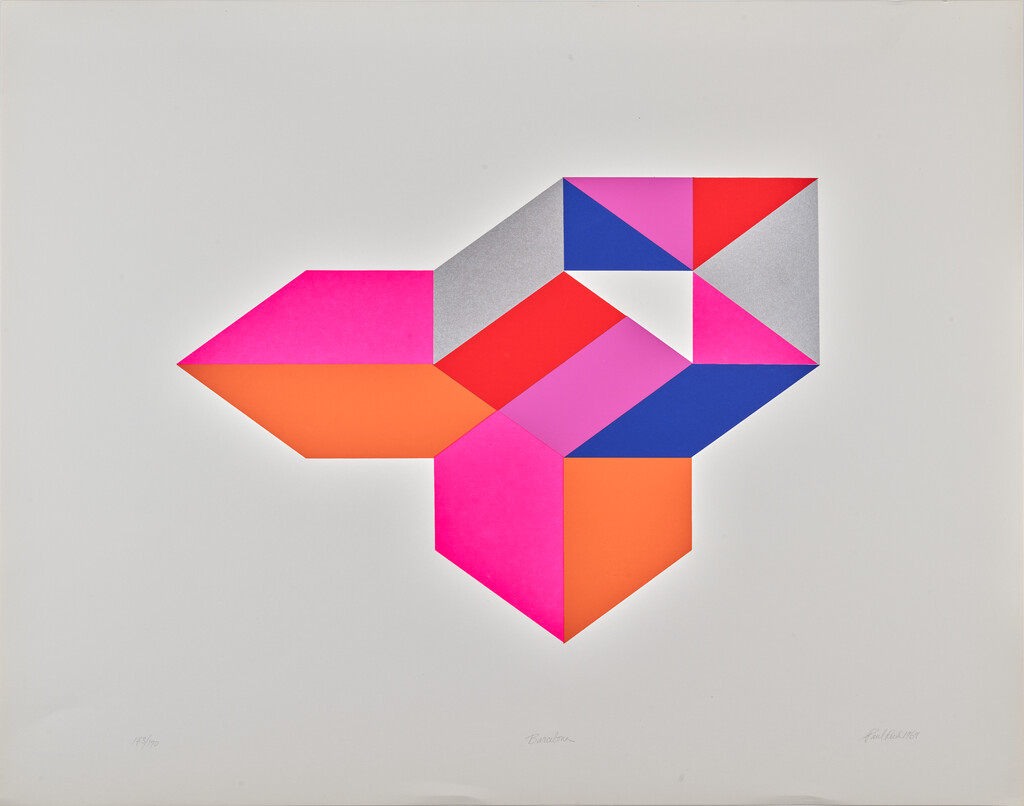
DS: I was so sorry I couldn’t come out there to see it. But the catalog that you did is just one of the most exciting catalogs I’ve ever seen, and it really showed Paul’s work. He was the first of the Washington Color School Painters that Lou printed for. I’m trying to remember who came after, but they were down the road. I don’t think Sam Gilliam thought he was really part of it; he was younger than all of them. And Lou didn’t print for Gene Davis until the late 70s, where he printed with Paul in ‘69, ‘68. We didn’t really know Gene. They had a wonderful friendship. They went to school together, waited at the bus stop. Other people sort of made it like they didn’t really get along, and both Gene and Paul were like, “What are they talking about?” They never had a problem that I heard about.
AT: What was the period like after you and Lou stopped working with Paul so much on his prints? Did you stay in touch? Did you stay close?
DS: Oh, yeah, we did. There was a lull where Lou decided he wanted to do his own prints. So there was a good ten years that he didn’t print for other people. In those days you had to have somebody commission, somebody to pay for it. And that was never the artist who had a chunk of money to pay for three month of studio time for a printmaker, so they had to come from elsewhere. But Paul was always coming over and visiting or Esther, or we were going over there, to their house. They would have Lou’s whole staff come over for dinner sometimes. And we knew their kids. It was a nice relationship I thought.
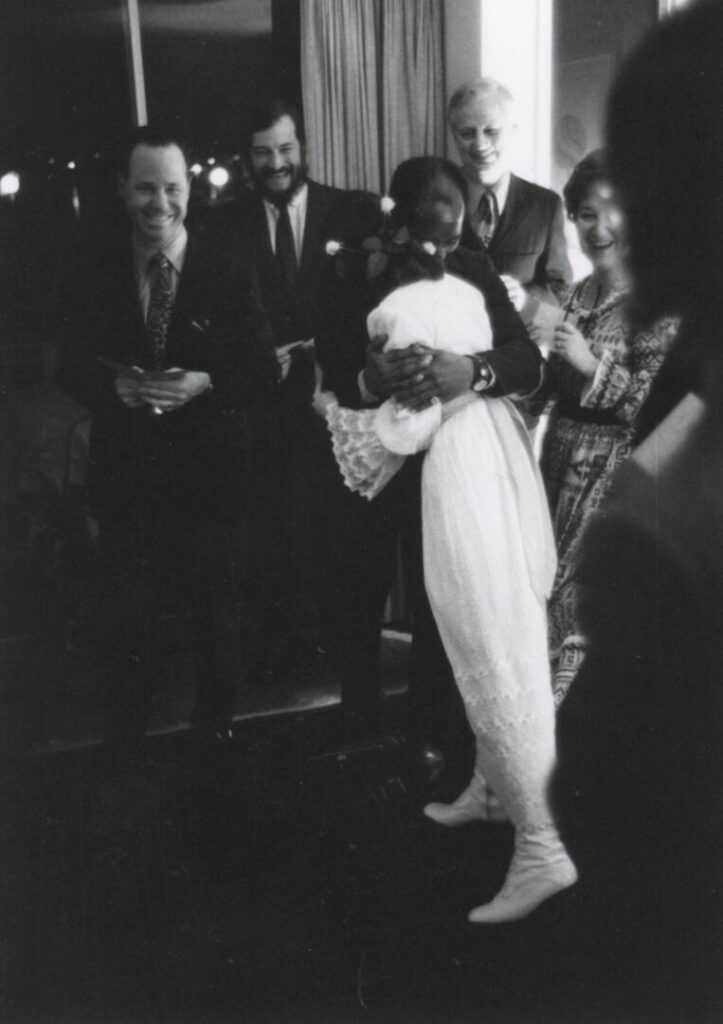
AT: Will [Stovall, your son,] shared some photos with me from your wedding.
DS: Lou’s idea for our wedding was for it to be different, and he based it on a Latin wedding ceremony. You had spokespersons. You didn’t have best man and all that stuff. So when it came down to it, I picked Paul Reed, so Paul Reed was my spokesperson. Lou had Phil Stern, I think. It was a great time. Paul and Esther were at the tiny wedding we had in somebody’s small townhouse. And then the next night we had a bigger reception at the Stern’s house. It was fun. We wrote all these things, and made a book, and we didn’t have much money, so it was like Xeroxed books.
AT: That sounds really special.
DS: It was special. It was a special time. Esther helped me with my hair.
AT: I’m wondering what sort of conversation you can imagine Lou and Paul having if they were there in the exhibition looking at some of their prints.
DS: That would be interesting because they both sort of meshed, and they weren’t chit-chatters about things. They just went down to the core of what they wanted to accomplish and how to do it and what each thought. And they each left each other space. Lou was a printmaker, and Paul was the artist that he was working for. It was really nice.
Paul was an amazing person. I remember years later we were at somebody’s house, an artist’s house, and they were talking about Gene Davis, mainly. And I said, “Well, I think Paul Reed is the most interesting person because he did everything.” He did sculpture; he was innovative. Gene did his stripes, and that was his niche, and Gene Davis was a wonderful, amusing, neat guy, but Paul was very unique I thought. And there was somebody who was a retired dealer who had just started to open up another place, and his ears perked up. And within a week he called Paul up to go see it. It was like he didn’t know Paul did sculpture; he didn’t know Paul did all kinds of things.
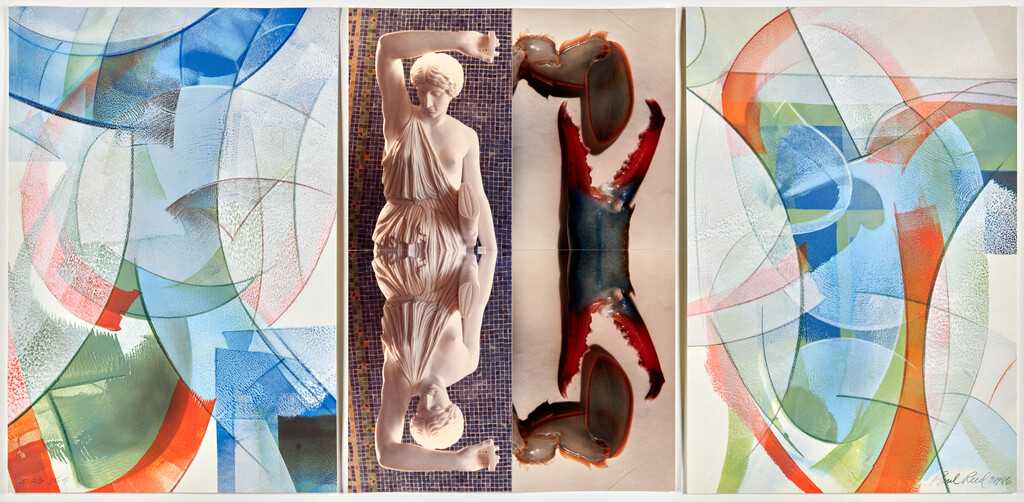
AT: It’s really remarkable. You’re talking about the different forms of art he explored, and the exhibition is laid out chronologically, so you can really see the biomorphic to the geometric then the shaped canvases and sculpture, then the prints, and then his photography and his collages.
DS: Right. We have a few—Paul was too generous with people if you want to know the truth. We’d go over there and he’d give us all these photographs that he had put together. You had to tell him no, almost, or he’d sort of give you the whole household.
AT: What else would you like to share about Paul Reed?
DS: We had dinners together. Esther was so much fun. Most of the time it was just the four of us, but sometimes it was with their kids or with other artists. But it was mainly just the four of us.
AT: How would you say that having that community impacted the art that you were making?
DS: Well, it was an exciting time in Washington, and I don’t think we’ve had anything like that since. And it was an overlap of the Washington Color School and the next generation, which was Lou and Sam Gilliam and other people. It was a fun time. All the galleries were sort of in the same area, near The Phillips Collection. And it was just warm and wonderful. If there was an opening, you’d just go from one to the other to the other. I wish we had those times again. And the artists were the same way. They got to know each other. They went to each other’s studios. I remember Paul’s studio. It was just so cool. It was in an alley. And it was wonderful to drop in and visit with Paul, or he would drop in and visit with us. And he would chime in and help with the kids because we did an open workshop for children on Saturdays. And Paul liked to come on a Saturday and pitch in and help out.
AT: It’s interesting to see too how when he lost his studio and began working out of his home how much smaller his works became but how adaptable he was to that.
DS: Right, I know. I can remember being there one time and we were like chit-chatting in one area where you had some art hanging up on the wall. This was after Esther died and he sort of took over the house. And suddenly Paul would get up and go flying down to the basement and come up. Then he’d say, “Come on down!” And we’d go down. It was just a maze of art and different kinds of art that he would do.
AT: I’ve talked with half a dozen people now for this project for Paul’s birthday, and I’m really struck by how consistent everyone’s stories are. It’s really beautiful that everyone has their own special memories of him and had their own relationship with him, but there are things about him that are very clearly: that’s who he was.
DS: That’s who he was, absolutely. He was a great man. And interested in other people. Sometimes that doesn’t happen with fame. He was just so generous with everybody. And different generations too, you know. It’s one thing to be generous with your peers but then suddenly—I’m not sure what the age difference was between Paul and myself, but I was like barely twenty when I married Lou, and so, Paul already had three kids. It was neat. I love your interest in Paul Reed because he was a special man.
Resources
The Legacy of the Washington Color School
—
This interview has been edited for length and clarity.