OKCMOA’s Communications Manager Amber Thompson spoke with Emily Lenz, Director of D. Wigmore Fine Art in New York City, about Paul Reed’s relationship with the gallery, D. Wigmore’s complementary exhibition, and Reed’s technique.
Amber Thompson: How did you first learn about Paul Reed?
Emily Lenz: Yes. Our gallery started handling Postwar Abstraction in the early 2000s, and we had included Gene Davis and Thomas Downing in several of those exhibitions, and a younger artist named Mark Dagley came to our gallery and suggested we get in touch with Paul. And for us when an artist we respect says we should look into another artist, we usually look into it. And Paul was included in the massive publication The New American Abstraction. We knew of his work already but didn’t know he was available. We started conversations with him in 2012, and we did our first exhibition with Paul in 2013.
AT: Was he able to make it there for the opening?
EL: No, he was in the hospital at the time. But we learned from his daughter Jean that he was very proudly distributing the catalog to everybody at the hospital. He got to see the catalog and feel good about the exhibition.
AT: Which of his works was the first for D. Wigmore to acquire, or were there several at once?
EL: As you see from the first show we did, called Paul Reed and the Shaped Canvas, we were originally really interested in his shaped canvases and also his early Satellite paintings. We’ve lent one to your exhibition. And those Satellite paintings, he had a whole show of them in New York. They’re a central image and then a fragment that’s sort of spun off with centrifugal force, and at the time his dealer in New York sold a lot of the small fragments separately. There were only so many of the intact, two-piece Satellites, so those were some of the first pieces we got at the gallery.
AT: Based on some of the things his daughter Jean shared with me, he didn’t always have the best relationship with galleries and wasn’t always as interested in that side of an art-making career, and she said the exception was Deedee Wigmore. I’m wondering, from your perspective, what made her work with him different?
EL: When we connected with Paul in 2012, he was really ready to share his life’s story. I think as his daughter said, there were other points in time when he was more interested in making than selling and marketing, which is pretty typical of artists; their happy place is in their studio. I think he was ready to work with us on telling his origin story properly. We’re a long-established gallery; we’ve represented artists for now four decades, so I think he saw that we were approaching his work with respect and professionalism, which put him at ease. What’s also really important for an artist is when we first went to visit Paul’s house, he could tell Deedee had a really good eye, and artists, no matter what, what they want to know is that if they send their work to a dealer, it’s going to be presented in the very best light. I think that was also helpful for Paul.
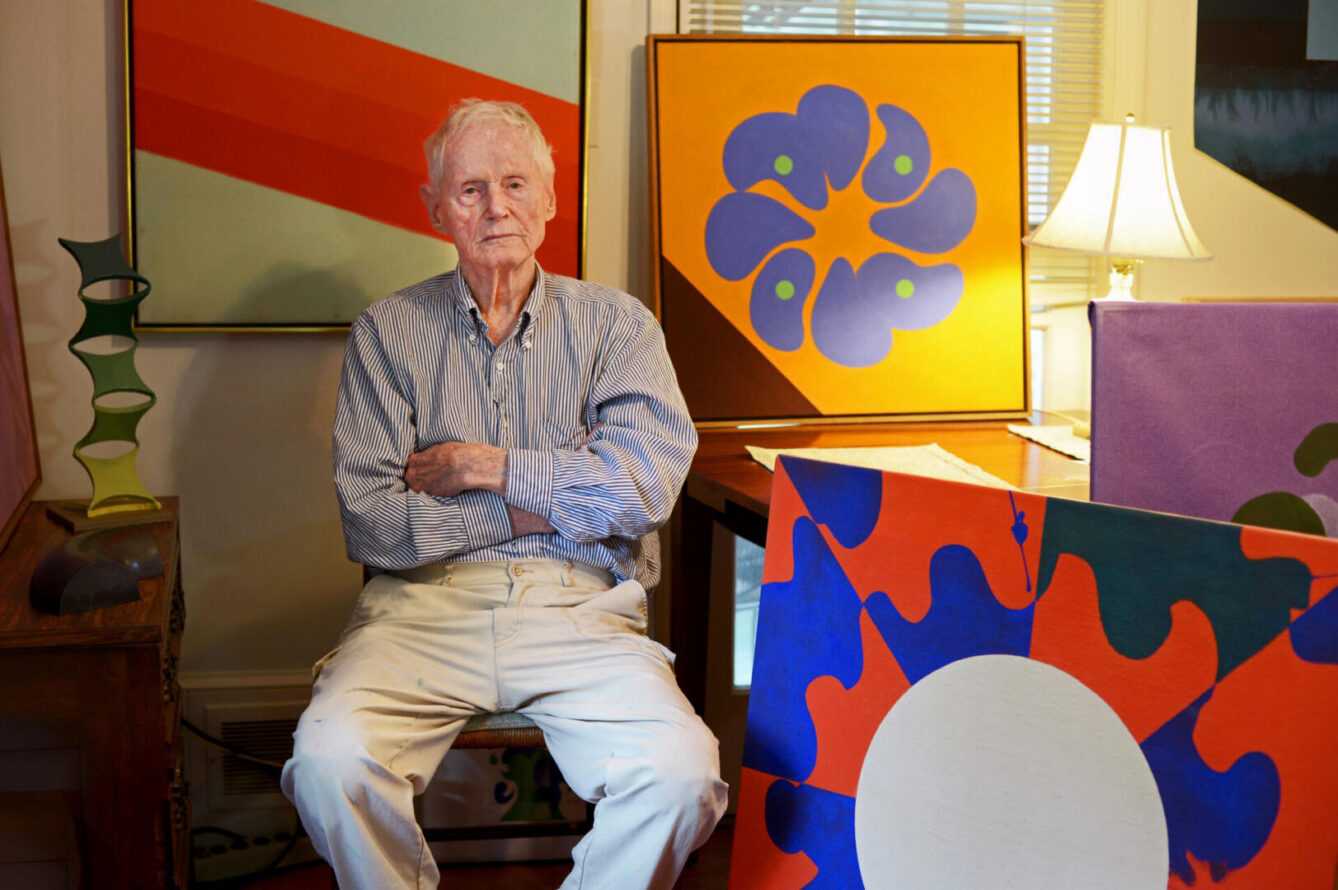
I think Paul was getting up there in years, and so he was in a reflective place instead of a productive place, and we’re really serious about our scholarship, and we aim to connect our artists with museums, like Oklahoma. I think he saw that this was really the right time to cooperate and part with some of his best works.
AT: In my conversation with Jean, she also mentioned that it was through D. Wigmore that the Museum was first in touch with the family about rights for No. 17 for merchandising and marketing.
EL: For a Matisse exhibition, which was fantastic. I feel like Matisse is strong in Paul’s early work, so I thought it was fantastic that the Museum really pushed to have Paul’s painting included in a traveling exhibition from the Centre Pompidou. And Oklahoma City, with its history of having acquired the whole of the Washington Gallery of Modern Art, it’s such an excellent place for Paul’s work to end up.
AT: Like you mentioned, we have one of the Satellite paintings on view in the exhibition and a couple of others, and I’m curious about your thoughts about D. Wigmore being part of this first major retrospective of Paul Reed and what that means both for this gallery and for his legacy.
EL: We love it. It’s fantastic. We are so glad that the Museum did such a significant monograph. We’ve got it [the catalog] on our desk here at the gallery during our exhibition, and I keep pulling out chapters to show people. I think your museum did a really great job of presenting his work, presenting what makes his work so special in terms of his technique with the new acrylic paints at the time. I don’t think today we sort of can appreciate how technologically advanced it was to be using the early plastic paints. Now, oil or acrylic, it’s all the same to us, but at that time, Paul was an early adopter, and I guess you could say adapter. He stained like the other members of the Washington Color School, but he really achieved an incredible line with his staining. The canvas can wick up the paint, and so to have the really precise, defined edges in Paul’s work, even with the biomorphic is really technically impressive. I was happy to see there’s a whole chapter about his technique and his use of transparency, because the new acrylic paints worked as glazes so differently than oils, so he was really able to put color theory into practice with the acrylic paints. You can see that becomes more and more a focus with him, kind of after ‘65.
I think your museum did a great job. I think it’s so wonderful that you come out of the exhibition and then see him with all of his peers. I don’t think another institution could to do it the same way you guys are able to. And then personally, I just loved those big galleries with the shaped canvases. I’ve seen one here, one there; we’ve handled some, but to see them en masse in such a big, open, white space was really fantastic.
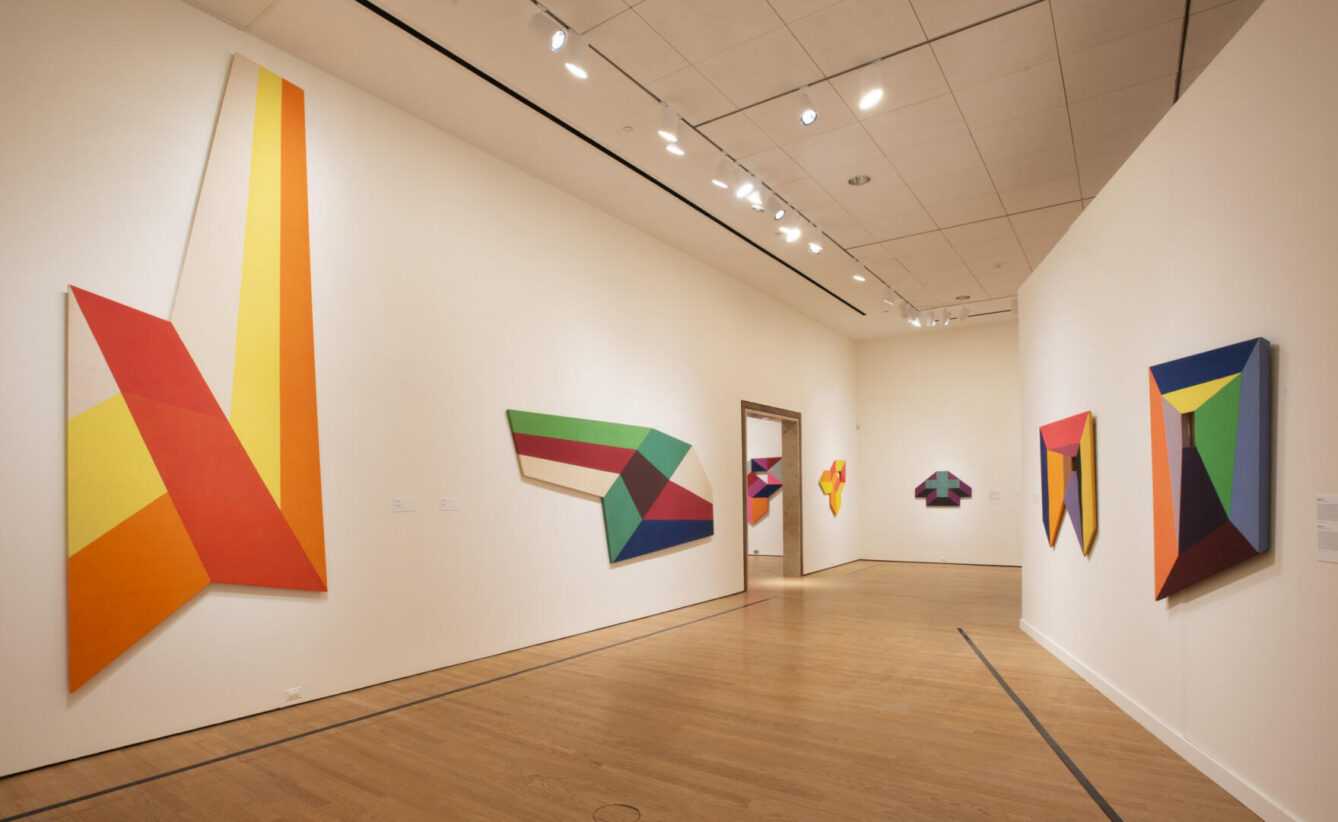
AT: You’re talking about entering into The Legacy of the Washington Color School gallery.
EL: And Paul was not alone, that’s part of what interested us from the beginning is that we knew his peers’ work, and the original Washington Color School was only six artists, so Paul’s an important figure there. But then I think with that legacy you see that there’s maybe the six original guys, but there’s really much more going on in DC at the time, and Paul was part of that because he was a teacher at the Corcoran for so long.
AT: You mentioned the complimentary show that you all [had from December through mid-February].
EL: Our show is very small. Your show covers from beginning to end. Ours covers just 1962 to 1968, which is when he really comes into his own with a defined style and then moves from the biomorphic to the geometric, so that’s the focus. We’re dealing with a much smaller footprint than your museum’s exhibition galleries. People come in and really get the quality of his craftsmanship and the evolution of his style. We talk to everyone who comes in the door. We show them, “This is where he starts; it’s a little bit loose; it’s a little bit all over. And then he becomes more and more focused to a center image with the disc paintings, and then he really starts exploring transparency. And once he’s achieved that, we go into the shaped canvas.” We’ve lent a shaped canvas to you, so we don’t have our biggie, but we have one other painting, and a couple of the collages in the opening of our gallery exhibition.
AT: Do you feel that there’s a point at which there’s more of an overlap between the biomorphic and the geometric? Is there a series that hits in the middle?
EL: Yeah, we call them the petal paintings, with the four biomorphic bean shapes and then the four dots that create the sort of suggestion of an inner square. On those paintings usually it’s a single field of color and the two corners; he paints another layer on top of them, so it ends up being three colors, but they have an interesting relationship. And I think that’s really the pivot point of his work from his biomorphic to the geometric.
AT: Where do you see D. Wigmore going from here with Paul Reed and continuing that scholarship on him?
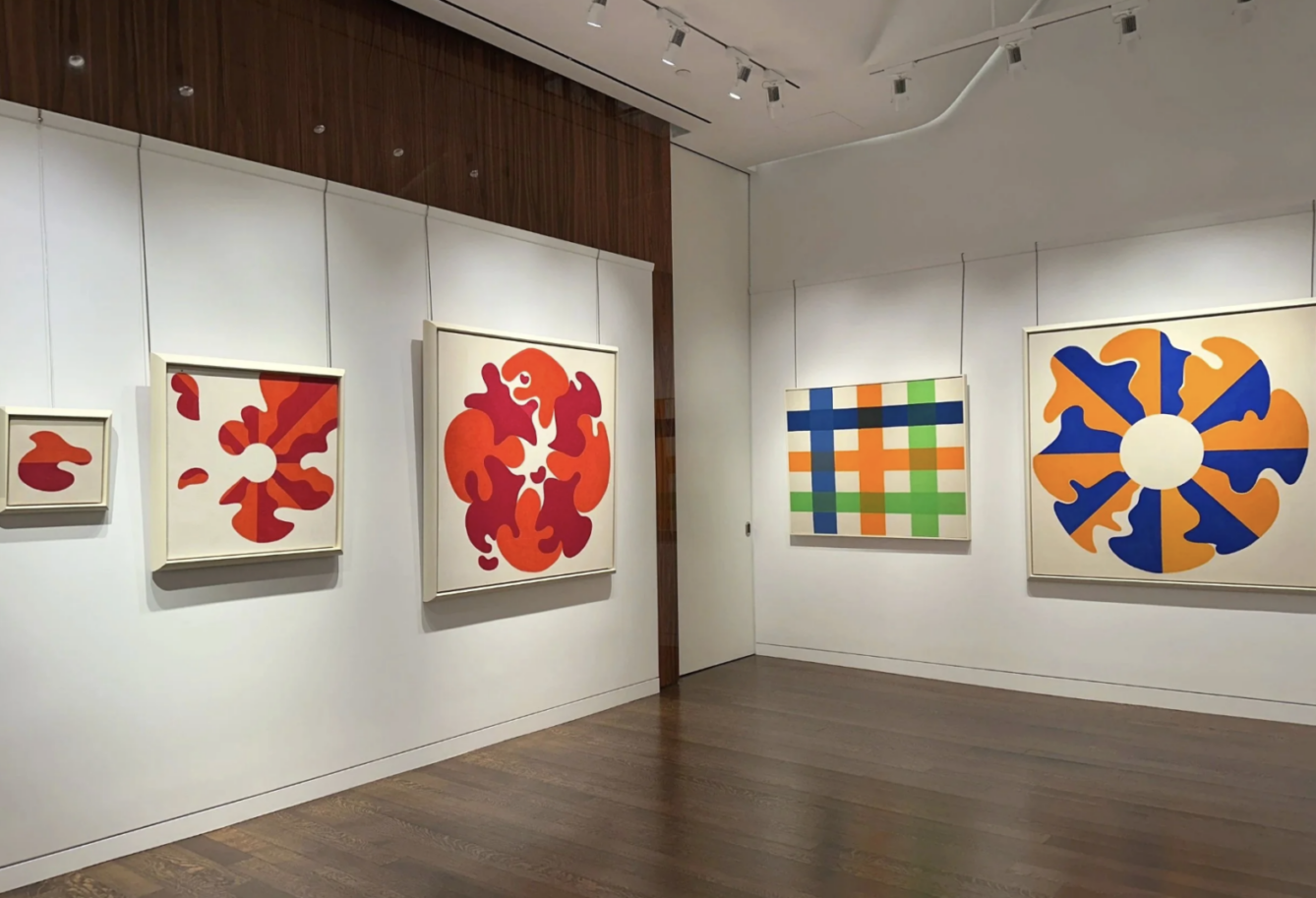
EL: We’re going to be interested in seeing what the catalog does. So often with these exhibitions, it’s the catalog that lives on, and other curators come along and start asking questions. I think we would love to see every museum that has a Kenneth Noland on view to have a Paul Reed on view as well. We’re not there yet, but that’s something we’re aiming for. And in the meantime, we’ll keep offering the works here at the gallery. Gene Davis worked huge all the time; Paul really was comfortable working in a very broad scale. We have paintings here that are perfect for collectors’ homes, probably too small for museums. And then we’ve got biggies, which should go to museums. That’s what we’re aiming for.
AT: Is there anything else you’d like to share?
EL: [I’m] just thrilled. I know this exhibition took a lot of years to come together. We all know that Paul’s work, he did keep it in his home, so a lot of the work is in really beautiful condition because after he exhibited it, he took it off the stretcher and rolled it up so we know how the Museum has had to put in a lot and I think the effort’s really paid off, and it’s a beautiful show.
RESOURCES
D. Wigmore Fine Art’s recent Paul Reed exhibition
Paul Reed: A Retrospective catalog
The Legacy of the Washington Color School
—
This interview has been edited for length and clarity.