Communications Manager Amber Thompson sat down with Maury Ford, Director of Collections and Exhibitions at the Oklahoma City Museum of Art, to discuss OKCMOA’s years of preparation behind Paul Reed: A Retrospective and the Museum’s standing as one of the most important repositories of Reed’s work.
Amber Thompson: After a decade of planning, we’re now approaching the end of Paul Reed: A Retrospective. How does that feel?
Maury Ford: It feels kind of bittersweet. This has been a real labor of love for almost a decade, and it’s a project that I’ve worked on for over half of my time here at the Museum. And it’s sad to see it go and sad to see it come to an end because we’ve all put so much work and effort into the exhibition. But I’m proud that it will continue on to another venue to where it can be enjoyed closer to where Paul Reed’s home is in Virginia. And then also I’m proud that we’ve published this important exhibition catalog so that the story of Paul Reed and the exhibition can live on long after the exhibition closes.
AT: Can you talk a little about those early conversations with Jean and what it was like seeing some of the works she would end up gifting to the Museum?
MF: Sure. I wasn’t really involved a lot in the early conversations directly with Jean. I got involved once she had already seen Matisse in His Time. So I was able to meet her at the opening for that event. I remember her being very pleased and kind of blown away that we would include her father in this exhibition and seeing her father’s work close to the works that inspired it by Matisse. I remember her being pretty overwhelmed.
So after that, the negotiations started with her wanting to give the Museum a gift of artwork. And I remember as a staff we were not expecting anything more than a few paintings, maybe some prints. But then as negotiation continued, it became clear that she wanted to make this a real legacy gift and make the Museum one of the most important repositories of Reed’s work.

In early 2017, I was part of a group of staff that flew out to Phoenix, Arizona, where Jean was living at the time, to basically view the works that she had in the estate’s collection. And everyone that went on that trip was of the understanding that we could probably just make the selections we wanted while we were out there and return home. It started with meeting Jean at her house and seeing some of the great works by Reed that she had chosen to display in her personal space, some of which are in the retrospective. Then she took us to the storage facility where the remainder of the works were stored, and I remember the door opening and it just being packed floor to ceiling with boxes, rolled canvases. Floor to ceiling basically. And it became very clear to all of the Museum staff that if we really wanted to do this correctly and not rush into it, we were going to need, one, more time, and two, a place where we could better access the works and safely view them and unroll them and make our decision. And so we decided at that time that we were going to pack the entire storage unit and then have a fine art service company bring the entire contents of the storage unit back to Oklahoma City so that we could make our selections here. And during that time, like I said, we were still of the impression that we would get maybe at the most fifty works and that it was going to be in a couple of gifts. And we of course were focused on the 1960s, which is most closely resembling the two Reed paintings in the collection we already had. But Jean wanted to build her father’s legacy through this gift. She wanted us to incorporate his entire career, not just his most well-known decade. At that point we started to negotiate how many works would actually come to the collection, and Jean was open to as many as it would take to accurately tell the story of his career.
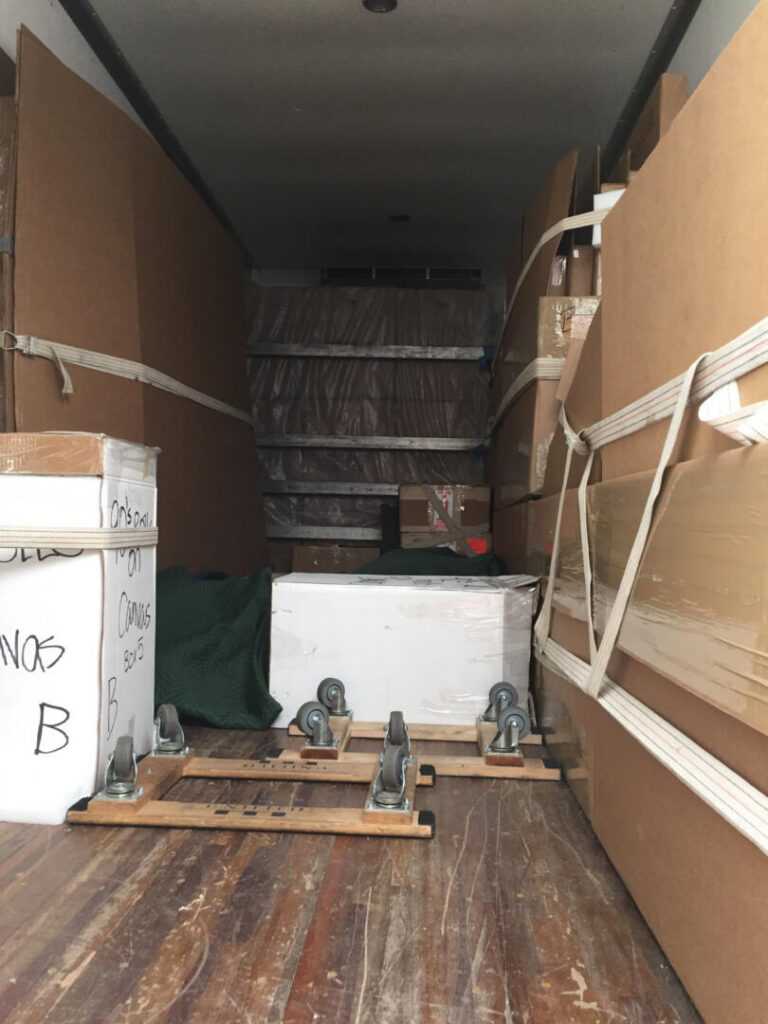
Then our curators [and] myself started the long process of going through the entire estate’s collection after we had brought it back here to the Museum and made the selection of 125 works.
AT: What moment of this process have you felt the most proud?
MF: There’s been a couple moments during the process. I think the first moment to me that I really got the sense that this was actually happening and that all of our work was starting to come together was getting my hands on the first advance copy of the catalog. It was a lot of work to put this publication together, and Paul Reed really doesn’t have a lot of scholarship about him. Not only does this serve as an exhibition catalog, but it also hopes to serve as the main scholarly publication on Reed. So having that in hand and seeing how good it looked and knowing how important it would be in the future, that was a big source of pride.
Then I think the other moment I felt most proud was when Jean and her family got to see the exhibition for the first time. And seeing and knowing that they were pleased and happy and excited for the exhibition, that was a big relief and a big source of pride.
AT: Has your perspective of Paul Reed, his work, his legacy shifted any since beginning this process?
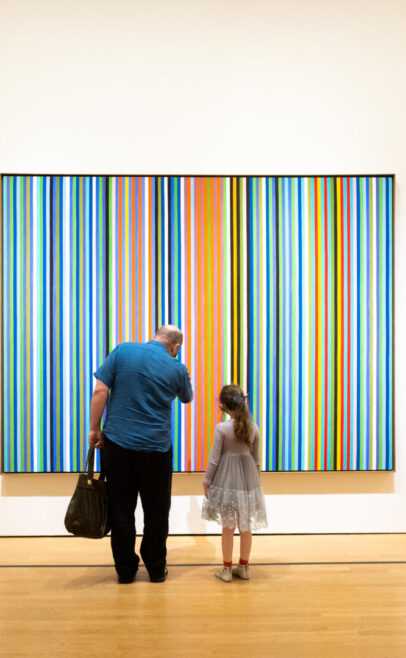
MF: I would say it has. I’m not an art historian; I wasn’t trained as an art historian. And so, my knowledge of Paul Reed started when I started here at the Museum, and at the time, we had three representatives of Reed’s career. We had a Hackensack painting that was gifted to us and then No. 17 from the WGMA collection, and then we had a Gilport painting. So I was aware of probably Paul Reed’s most well-known period, the 60s—mid-60s and early 70s. But outside of that I didn’t really know too much about Paul Reed the artist or Paul Reed’s career. And so in the course of this exhibition, and one of the things that we wanted to get across to the visitor in the exhibition was the fact his work varied over his career. He took inspiration from a lot of different places. And unlike the other members of the Washington Color Painters, who kind of found their style of painting and stuck with it—like Kenneth Noland doing the targets and Morris Louis doing the drape paintings and the staining, they kind of found that niche and stuck with it. But Reed was never really concerned about critical reception or really wasn’t concerned about commercial success, and he was really a true artist, and he found inspiration basically everywhere. His style changed from the 50s all the way through 2014 when he’s doing his last works. That freedom of not being bound by critical interpretations or needing that commercial success allowed him to experiment and do the things that he wanted to do. You see that in all the different series and the shaped canvases and then getting into sculpture and printmaking and photography and computer-generated energy. That was one thing I was not aware of, was how much his style changed and how adaptable he was.
The other thing that kind of came out through this process was how cerebral Paul Reed was. On paper he doesn’t look like a scholar or an academic, but his artwork is very smart and very cerebral. He’s looking at geometry; he’s looking at how the work interacts with the wall and how it interacts with the space around it. He’s very gifted with color theory, and he’s looking at how colors interact with each other, how they layer on top of each other. And then toward the end of his life he’s having daily conversations with NASA scientists and really getting into deep, astronomical thoughts about the God particle and space and time. I guess I didn’t really think about or know how tied into very deep thinking his work was. And then just overall how much work he created over his career. Just creating multiple works a day for a sixty-year career.
AT: What do you hope or think the Museum’s relationship to Paul Reed will be after the exhibition closes? How does that continue?
MF: I hope it brings Paul Reed back into the conversation as one of the most important American artists of the Postwar period. I also hope that through this exhibition—we’ve put Paul Reed’s work in context with the Washington Color School in this exhibition. You exit out of the exhibition and into a gallery that’s devoted to the Washington Color School and the artists of that. I’m hoping that in the future we can put Paul Reed into a context with the larger Postwar art historical movement, not just shoehorning him into this decade. And not to say that the Washington Color School and the Washington Color Painters were not important; I think that’s another part of this that I hope this exhibition brings to light is how important that movement was in the nation’s capitol. But really I hope it puts Paul Reed into the conversation of Postwar art rather than just one movement in the 60s in Washington, DC. And then I hope that we continue to kind of be a repository for knowledge about the artist and kind of a source of information for the future researchers and curators and students who get interested in Reed and the Washington Color School. I hope that it really helps the Museum to become a hub or a source of information for those seeking knowledge about Reed.
I think overall it’s just treating Paul Reed as you would treat any other major artist and trying to get them on view as much as possible and in as many different contexts as you possibly can.
AT: The span of time that you’ve been working on this, that’s sort of evident to you based on your daughter’s growing up. She was really young when you started this, and she’s a teenager now.
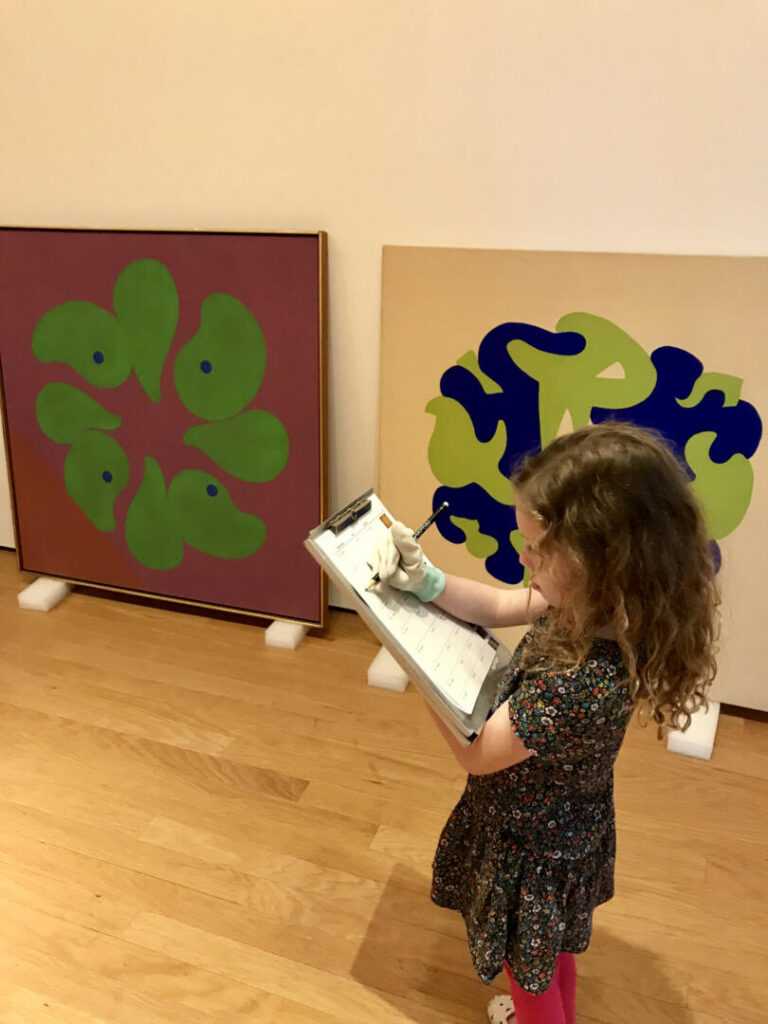
MF: When we started this donation process in 2017, she was still in elementary school. I can’t remember why, but I know we were bringing out a lot of these works that we had brought in from the estate and from various other galleries that Jean had some of the estate’s works consigned to. And I don’t remember why, but she was here at the Museum with me during the day. Either she got out of school early, or it was an early release day and brought her back over to the Museum, and she put on gloves and got a clipboard and it was mostly to keep her busy, but it made for some really great photos with her going around and just checking the works and doing her little reports on them. And it’s kind of wild, the exhibition planning process—it doesn’t really seem that long until you start thinking about in those ways. She was five and now she’s about to be in high school. That’s a unique way of looking at it.
AT: I think what I’m realizing is just how much of that parent-child relationship, to hear how much of a champion for her father’s work Jean has been. It’s fascinating because in a lot of ways I think it takes someone who’s that close to an individual to really say, “They weren’t just about this one thing.”
MF: Right. I mean, really, hats off to Jean and her children because without them, this wouldn’t exist. When Reed passed away, he left all of these paintings. His house was just overrun with his work. I think most people in that situation would feel really overwhelmed and not feel the kind of sense of duty that she’s felt in making this legacy for her father. She did a pretty excellent job given her limited knowledge of preservation and art conservation to really preserve this collection for the future. And her children have carried on that legacy, and so the fact that we’re able to do this exhibition and that anyone’s able to know about Paul Reed outside of the 1960s is probably due in large part to Jean and her children’s kind of love for his work and their need to create a legacy for him.
But there are a large number of people that kind of think that Paul Reed was important for a small period of time in the middle of the 1960s and he should be remembered as someone who exhibited in the 1965 Washington Color Painters exhibition [curated by Gerald Nordland] and that’s that. But you know, credit to Jean. She really wholeheartedly believes that people should know everything about her father and what a great artist he was and the type of life that he led. And so the fact that we’re able to create, or be part of creating, that legacy is pretty cool, and like I said, due in large part to her and her children’s dedication to his work.
Resources
—
This interview has been edited for length and clarity.