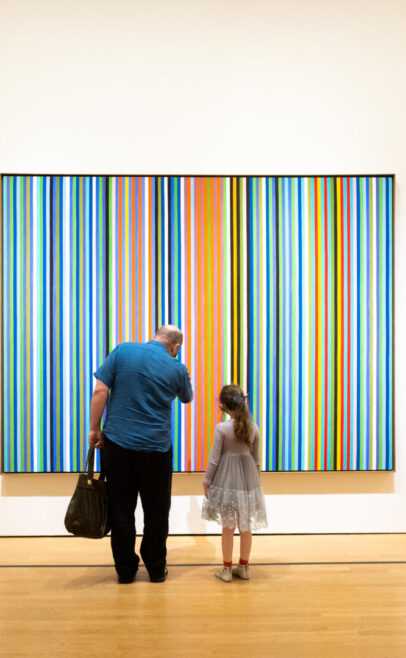
OKCMOA’s Communications Manager Amber Thompson spoke with artist Mokha Laget, one of Paul Reed’s students from his teaching days at the Corcoran in Washington, DC, about their friendship and his impact on her practice.
Amber Thompson: How would you describe Paul Reed as a teacher?
Mokha Laget: Everyone that I’ve spoken to about Paul says the same thing. He was a very gentle and a very kind teacher, beloved both by his students and his colleagues. What I particularly loved about him is the respect that he had for his students’ intelligence.
At the Corcoran, every teacher had a specialty, so Paul’s was color theory, and he was always thinking about the best way to develop curriculum for the particular students. He didn’t tell us so much what to do as how to think. I think he really cared that his students learned. Very generous, very encouraging.
AT: Can you describe how classes were structured at the Corcoran and how long you studied under Paul Reed?
ML: When I was at the Corcoran, many of the teachers were full time artists living in New York, and they commuted by train to Washington like three days a week. As a result, they brought their friends as visiting artists, and I distinctly remember Julian Schnabel coming, I think it was 1980; he was 29 years old; he was having a big show at Mary Boone. So that was an environment that exposed us to young working artists early on. And the Corcoran also had a unique way of pairing male and female teachers for every class, for every critique, so this would be an equal ratio. It was unusual for art schools at that time. But it was a powerful message to students and especially the female students.
At the Corcoran I took painting, drawing classes. I also studied ceramics, printmaking, sculpture, but I was particularly passionate about the photography department and black and white photography. It really was something that taught me composition, trained my eye. It’s something that I still use to this day. A lot of my free time was spent in the dark room there. There was something magical about the chemical process of developing images. And when I came to the Corcoran, it was from a very rigorous French education. I had also trained in Old Masters’ painting techniques in France, which are equally exacting, so it was something of a shock when suddenly I arrived at the Corcoran and I was told to let go of everything I knew, go big, let loose, have a merry old time.
But Paul was my first teacher there. He loved to have us experiment with shifting scales, to push us beyond what felt controlled or contained, and I loved that freedom. He really opened my eyes to that. His classes on complimentary colors really helped me to internalize that color is an active force, it’s not mere decoration, it’s a way to construct space and movement, without necessarily relying on a narrative. I connected with Paul because we understood the language of color in the same way, and coming from another culture and another language that meant a great deal to me. I mean, color has no geography. Color has no passport. It’s universally human. I don’t think I ever stopped being Paul’s student. His influence certainly didn’t end in the classroom. It stayed with me. Even when he was in his nineties, he would make me think. And I wrote a number of quotes actually, and I’ll read you one for instance, that has to do with color. He said, “Color is in your blood. Color, like poetry, is something you pass along, your sensibility. That’s your gift. Like your DNA or fingerprint, it’s yours, and in the end, it’s what has value.”
AT: Did you see much of his work while you were his student at the Corcoran?
ML: Not so much. The policy at the Corcoran was that the professors never showed their work to the students. They didn’t want to influence us in any way, so Paul never really talked about his work either, in the classroom. The classes were really focused on pushing us to think about what we were trying to do. And it was way before the internet, so it was hard to find images unless you looked at art magazines and catalogs and stuff.

AT: So you stayed in touch with Paul after you left the Corcoran?
ML: We stayed in touch on and off over the years, since I would go to DC periodically. Not so much in the first few years, but we really became close after his wife Esther died. I would say the last twelve or so years of his life, we communicated; we spoke over the phone. He was very voluble. He really loved to talk about art and ideas, so these conversations would go on for quite a while. And of course, I would visit him in Arlington when I got to DC, and I loved those visits, because the first thing we would do is I would get to the house and we would go behind his home, he had this little park, and we would walk in the trees, and we wouldn’t talk much, and he would point to things, compositions or light, or color. And then we would go back to the house, and we’d open a bottle of wine, and we would talk about art or poetry or physics, quantum physics he was into a lot towards the end of his life. He listened to books on tape. And we would show each other our works. And I learned a lot from those exchanges. I remember probably the best compliment he paid me was one day he said, “You keep your eye on the target, and I just might rip some of your stuff off.” Like, absolutely. Please do.
AT: You were here for the opening of the retrospective. What do you think of the exhibition and its relationship to his legacy?
ML: Well, Paul didn’t have the same critical exposure as many of the Washington Color School artists. The irony is that he outlived them all, so he had a lot more time to paint, and I think the retrospective is something that is very necessary and timely. And it recognizes Paul finally as the key figure within the Washington Color School. I mean, he pushed color and experimentation; he was extremely curious. I spent a long time in the show, actually, and some paintings I was kind of reverse engineering his gestures to figure out how he was putting down these transparencies, and especially those multiple overlays when they turn into this rich black that’s just made up of pure color. And I’d say also his sculptures were not very well known, so that was just a lovely array to see. But it will I believe continue to support Paul’s legacy. I think he was one of these artists who was maybe not as out there, ambitious, and sociable as some of the other ones, but he was an extremely thoughtful and intellectually curious artist.

I’ll give you a story that gives you an idea: During a visit in 2013, I remember he told me—he was undergoing chemotherapy and radiation at the time, and he was completely exhausted. He’d been listening to books on tape, and one in particular on the boson, the quantum particle. And he was trying to figure out how to translate a particular problem that came up for him while listening to quantum physics and so in the middle of the night, he has an idea. He was completely exhausted, he was drained, but he gets up and he goes down two flights of stairs to his studio basement, and he paints this idea, and it’s two o’clock in the morning because he just had to see what it looked like, what this idea, the potential solution to this problem he had in his mind. And he would say, “I don’t know how the energy came to me, but I just had to do it.” And after that, he climbed back two flights of stairs and got into bed and said, “I slept quite soundly after that.” And it’s quite amazing, ninety-four years old.
AT: Is there anything else you’d like to share about Paul Reed, the Washington Color School, or your own work?
ML: The Washington Color School, I barely knew about them when I first arrived in DC. I would occasionally run into Gene Davis or Leon Berkowitz at the Corcoran initially they were teaching the open program, and I knew that there was a group of them as I learned, Morris Louis had taught in DC as had Kenneth Noland, they had all connected with Howard Mehring, Tom Downing, and later, Sam Gilliam. But the year I got to DC in 1977, there was a big retrospective of Noland’s work at the Hirshhorn and the Corcoran, so there was a pretty strong influence there. They were Washington’s artistic legacy in many ways. But I was part of a younger generation, and I wondered what would come after that. What was DC going to do?
The summer of my first year, I was invited by Gene Davis to be his studio assistant for a summer, which turned out to be four years, and that was also a transformative period because not only I could see the canvases and mix colors in a professional studio, but I also ended up painting a lot of those stripes works on my hands and knees. And like I said, some of these other Color School painters had a very different personality. Gene was very ambitious and dynamic, out there in the world. But it taught me a lot about the discipline of being a professional artist as well. And he had a very improvisational quality in his approach. He would say, “I shoot from the hip” or “I play by ear.” I remember someone asked him how he chose his colors and would say, “Well, that’s like asking a hen how she lays her eggs.” I have a lot of memories from my time in Washington. But Paul was just somebody so special, and that kindness and encouragement and generosity, that sense of always being a peer to him from the student days was really just a strong spiritual, emotional, artistic gift that I will always keep inside me. He’s always with me.
RESOURCES
Solar Offset by Mokha Laget in OKCMOA’s permanent collection (on view in The Legacy of the Washington Color School)
—
This interview has been edited for length and clarity.